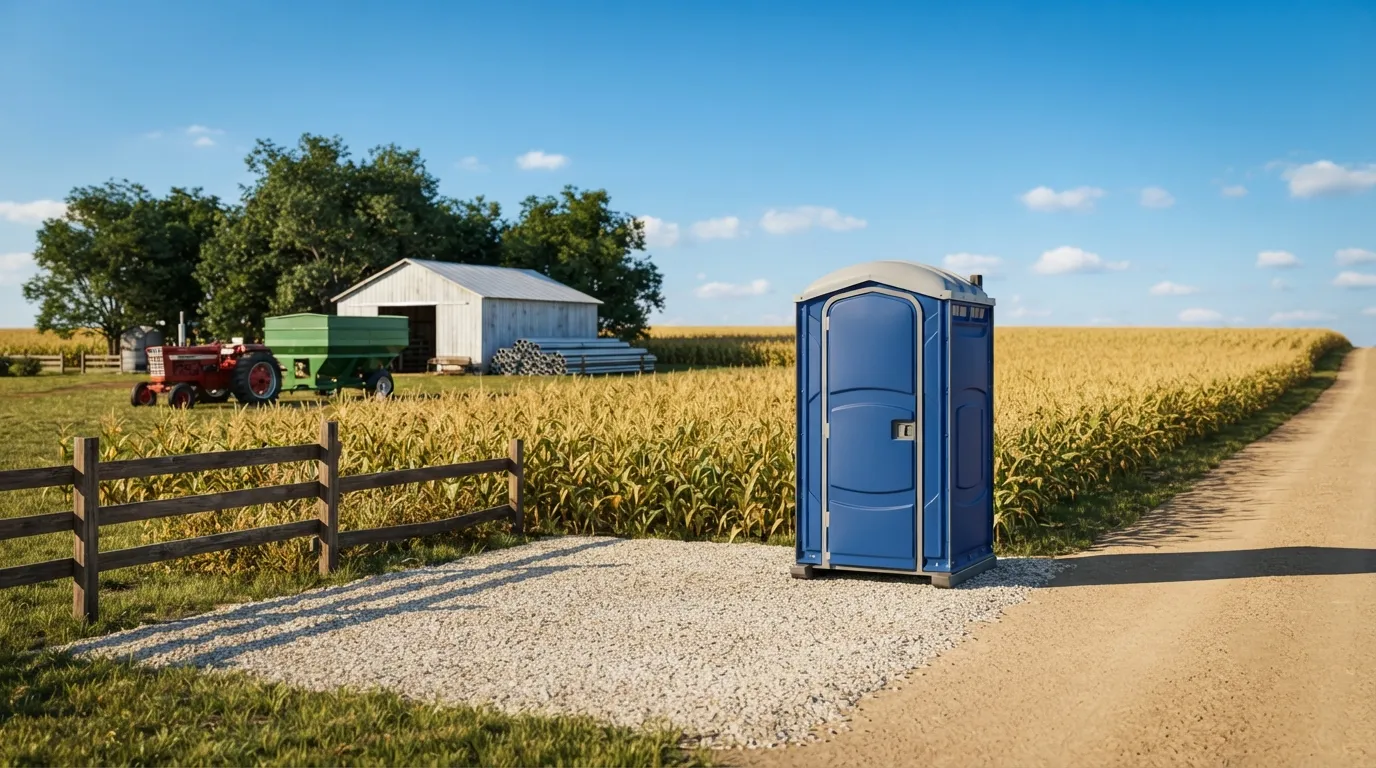
Farm crews need one toilet per 20 field workers under OSHA 1928.110, plus potable water within a quarter mile walk. Vallejo Porta Pros sets up standard units and handwashing stations on Solano County ranches and vineyard sites, with weekly service built around harvest schedules and crew size.
OSHA 1928.110 sets the field sanitation baseline: one toilet facility per 20 hand-labor employees, reachable within a quarter mile of where people are working. That rule was written for agriculture specifically, so it applies whether you are running a vineyard crew outside Vallejo or a seasonal harvest operation further out toward American Canyon, 6.2 miles north. A standard porta potty rental covers most crews, and each unit carries a 60 to 70 gallon holding tank on a footprint of about 44 by 48 inches, so it drops into a fence line or field edge without eating up work space. If your crew count changes with the season, how many porta potties do I need walks through the math past the basic ratio. Larger operations sometimes stack ADA units into the mix too; the placement rule for those, ADA restroom requirements, calls for at least 5 percent of a cluster to be accessible under ADA Standards 213.2, with never fewer than one. We deliver and service across Vallejo, and the same crews often ask about portable toilet rental for a fixed barn location and emergency porta potty rental when a labor contractor shows up on short notice for a two-day pick.
Handwashing matters more on a farm than almost anywhere else, because of dust, chemical handling, and food contact. If your crew applies pesticides, herbicides or other spray treatments, OSHA 1926.51(f)(1) requires washing facilities specifically for that contaminant exposure, and that rule is not a general handwashing mandate, it only kicks in with paints, coatings, herbicides or insecticides. Separate from that, 29 CFR 1910.141(d)(2) requires soap and a towel or hand-drying device at any washing station; hand sanitizer alone does not satisfy it. A handwashing station rental or a portable sink rental placed next to the toilet cluster covers both rules at once. Some operations lean on gel dispensers for a quick fix between rows, and hand sanitizer station rental explains where that is fine and where it falls short of the standard. General potable water is its own requirement too, under OSHA 1926.51(a)(1), which is worth checking against your current well or tank setup before harvest starts. For the full rundown on what counts and what does not, handwashing requirements breaks it out further than we can here.
Pricing depends on unit type and how long the season runs. A standard unit rents by the day, week, or month, and a monthly harvest contract costs less per day than a short weekend rental would.
| unit | day | week | month |
|---|---|---|---|
| standard | $100 - $350 | $130 - $500 | $125 - $325 |
| deluxe | $85 - $1,200 | $150 - $290 | -- |
Delivery adds a separate fee, typically $50 to $150 for a week-long placement, and that cost holds whether your farm sits inside Vallejo proper or out toward Benicia, 7.8 miles east. Full cost breakdowns live at porta potty rental cost, and if you are pricing a single day against a season, porta potty rental per day and monthly porta potty rental both lay out the math side by side. Crews running a longer contract, from planting through harvest, generally do better with the monthly rate than repeated weekly renewals. If your farm also needs a dumpster for green waste or packing debris, roll-off dumpster rental covers that separately, and a 10 yard dumpster rental is usually enough for prunings and pallet scrap between deliveries.
Weekly service is the baseline under ANSI/PSAI Z4.3, built around 10 users over a 40 hour week. A larger crew or a longer workday needs more frequent pumping, so we schedule service against actual headcount rather than the calendar default. Ask about mid-week add-on visits during peak harvest.
Yes, but placement matters for runoff and access. Keep units on stable, level ground away from irrigation trenches and wellheads. Porta potty placement guide covers clearance and ground conditions in more detail than we can here.
If units are clustered for a crew, ADA Standards 213.2 requires at least one accessible unit per cluster, minimum 5 percent. See ADA accessible porta potty for what that unit includes and how it differs from a standard one.
Cold weather changes tank service needs and freeze risk. Porta potty in winter covers antifreeze treatment, service frequency, and placement changes for the wet season.
Yes. We route service across Vallejo and out to Hercules, 9.3 miles south, and Martinez, 14.3 miles southeast, on a shared schedule. Contact us through request a quote with site addresses and crew counts for each location.
Yes. Vallejo Porta Pros delivers farm and agricultural restrooms across Vallejo and the surrounding metro, with same-day and next-day drop-off available on most orders.
Pricing depends on the unit and how long you need it. See our cost breakdown and request a free quote for an exact figure.
Standard rentals include scheduled service — a pump-out, a clean, a restock and fresh deodorizer. Busy or hot-weather sites can be serviced more often.
Call now or request a free quote — clean units, on-time delivery, transparent pricing.