Race restrooms need one placement per 200 to 300 runners near the start corral, plus units staged along the course every 1.5 to 2 miles, and at least one ADA unit per cluster under ADA Standards section 213.2. Vallejo Porta Pros builds the layout around your course map, not a guess.
Start with the crowd, not the course. A 5K with 400 runners behaves differently than a half marathon pulling 2,000, and your race restroom count has to reflect both the field size and how long people stand around before the gun goes off. Vallejo Porta Pros typically stages standard portable toilets at a ratio built for pre-race lines, since that's when 80 percent of the demand hits, then trims the mid-course count down since runners don't linger there. OSHA's construction ratio in 1926.51(c) calls for one toilet per 20 workers on a job site, and while a race isn't a construction crew, event planners in Vallejo use that same one-per-crowd-segment logic to avoid long lines at the corral. Add at least one ADA accessible unit per cluster, per ADA Standards section 213.2, and make sure the approach path meets the 36 inch clear width required under ADA Standards section 403.5.1. For a finish-line festival with beer garden or food trucks, add a handwashing station near the vendor area regardless of runner count. Not sure how many units your bib count needs? Run it through our porta potty calculator guide before you request a quote, or just call and describe your course.
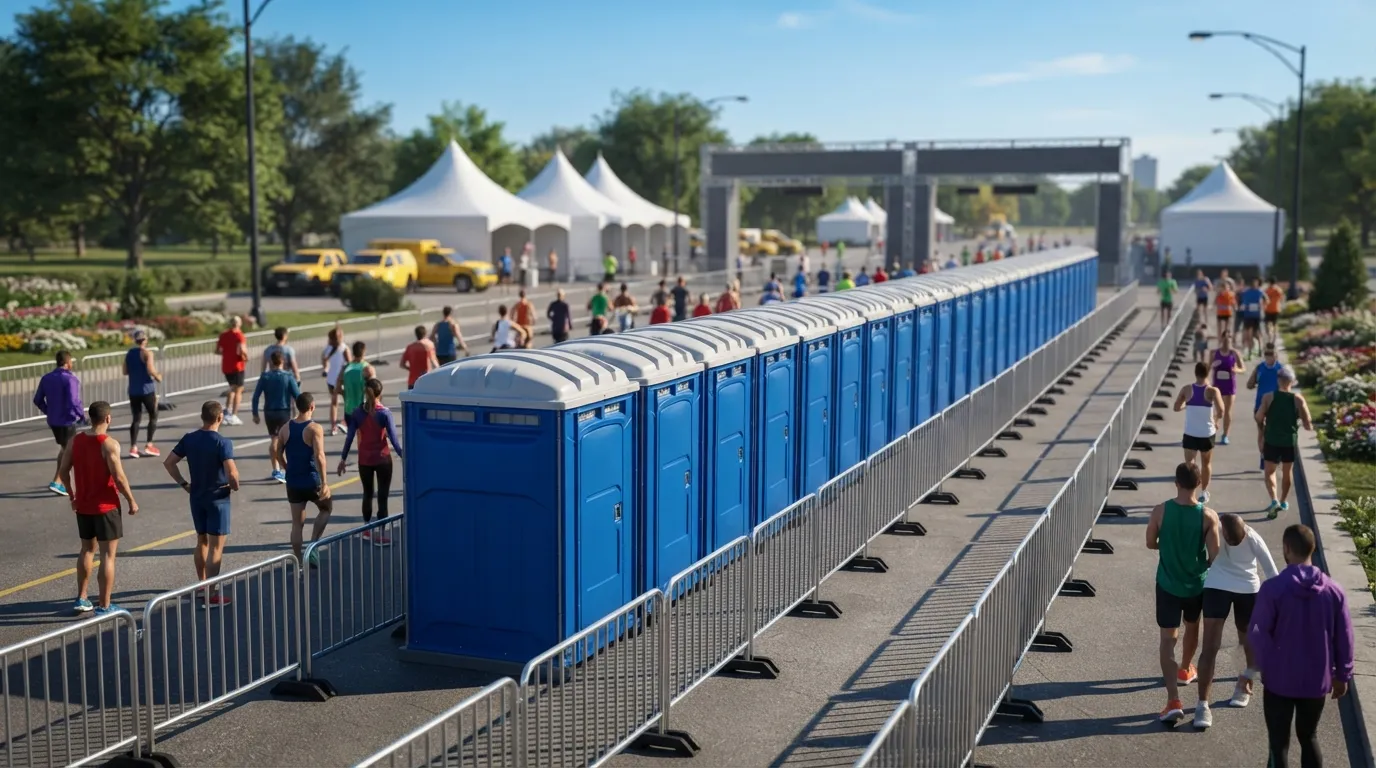
Put them at the start corral, every water stop past mile 2, and doubled up at the finish line chute. Vallejo's course layouts near the waterfront and downtown corridors mean tight turning radii for delivery trucks, and Vallejo Porta Pros plans routes around that. A standard unit runs about 44 by 48 inches on the ground and stands roughly 92 inches tall, small enough to tuck against a curb or parking strip without blocking a sidewalk. Placement near a mile marker means runners see it and use it, so don't hide units behind a tent or a sponsor banner. If your race also needs temporary fencing to corral spectators away from restroom lines, coordinate that install with the same delivery window to save a trip charge. Races that run through the evening or start before sunrise should also budget for a light tower at any restroom cluster set back from streetlights, since OSHA's illumination guidance in 1926.56(a) sets minimum lighting levels for work areas and the same logic keeps runners safe finding a unit in low light. If your finish line festival needs power for a timing tent or PA system, a temporary power pole staged near the restroom bank is worth planning early. Bracing that pole matters: knowing how to brace a temporary power pole starts with anchoring the base plate to a stable, level pad, guying it if it's freestanding, and keeping the run of cable clear of the restroom walkway so nobody trips crossing to the ADA unit.
Race pricing depends on unit count, event length, and whether you need a same-day teardown or a multi-day hold for a weekend festival. A typical marathon event package prices per unit for the event window rather than by the day, and add-ons like an ADA accessible unit or a deluxe flushable unit for VIP or sponsor tents carry their own rate.
| unit type | event rate | notes |
|---|---|---|
| standard | $200 to $800 | per unit, full event window |
| ada | $120 to $240 | per unit, weekly rate often applies to multi-day events |
| deluxe | $150 to $290 | per unit, weekly rate for extended festivals |
| delivery fee | $100 to $500 | per event, distance and access dependent |
Ask about the porta potty rental cost breakdown if you're comparing a single-day 5K against a full weekend festival, since a monthly rental rate doesn't apply here but a weekend rate might if your event runs Friday through Sunday. Vallejo Porta Pros can also fold in a restroom trailer for a headline sponsor area or VIP finish tent if the budget allows it.
Book as soon as your course map and runner count are locked, ideally 4 to 6 weeks out for anything over 500 runners. Vallejo road closures and street permits can shift delivery timing, so early scheduling protects your placement plan and avoids a rushed emergency porta potty call the week of the race.
Yes. ADA Standards section 213.2 requires at least one accessible unit per cluster regardless of total field size, with no exception for smaller races. One accessible unit per restroom bank covers most local 5K and 10K events in Vallejo.
Yes, and for anything over a 10K distance you should. Stage units near aid stations past mile 2, spaced so no runner covers more than roughly 2 miles without an option, matching how construction site services plan clusters across a large footprint.
Units still function, but approach paths get slick. ADA Standards section 302.1 requires stable, slip-resistant surfaces, so Vallejo Porta Pros recommends matting or gravel pads at high-traffic clusters before a wet forecast.
Yes, especially near food vendors or a beer garden. 29 CFR 1910.141(d)(2) requires soap and towels or a hand-drying device at washing facilities, and hand sanitizer alone does not meet that standard for vendor areas.
Yes. Vallejo Porta Pros delivers marathon and race restrooms across Vallejo and the surrounding metro, with same-day and next-day drop-off available on most orders.
Pricing depends on the unit and how long you need it. See our cost breakdown and request a free quote for an exact figure.
Standard rentals include scheduled service — a pump-out, a clean, a restock and fresh deodorizer. Busy or hot-weather sites can be serviced more often.
Call now or request a free quote — clean units, on-time delivery, transparent pricing.